 ChessStrategy.org
Imbalance reading
Learn to read a position
Every position is a set of differences between the two sides. Strong players spot the few that decide the game, and plan around them: an idea made famous by Jeremy Silman.
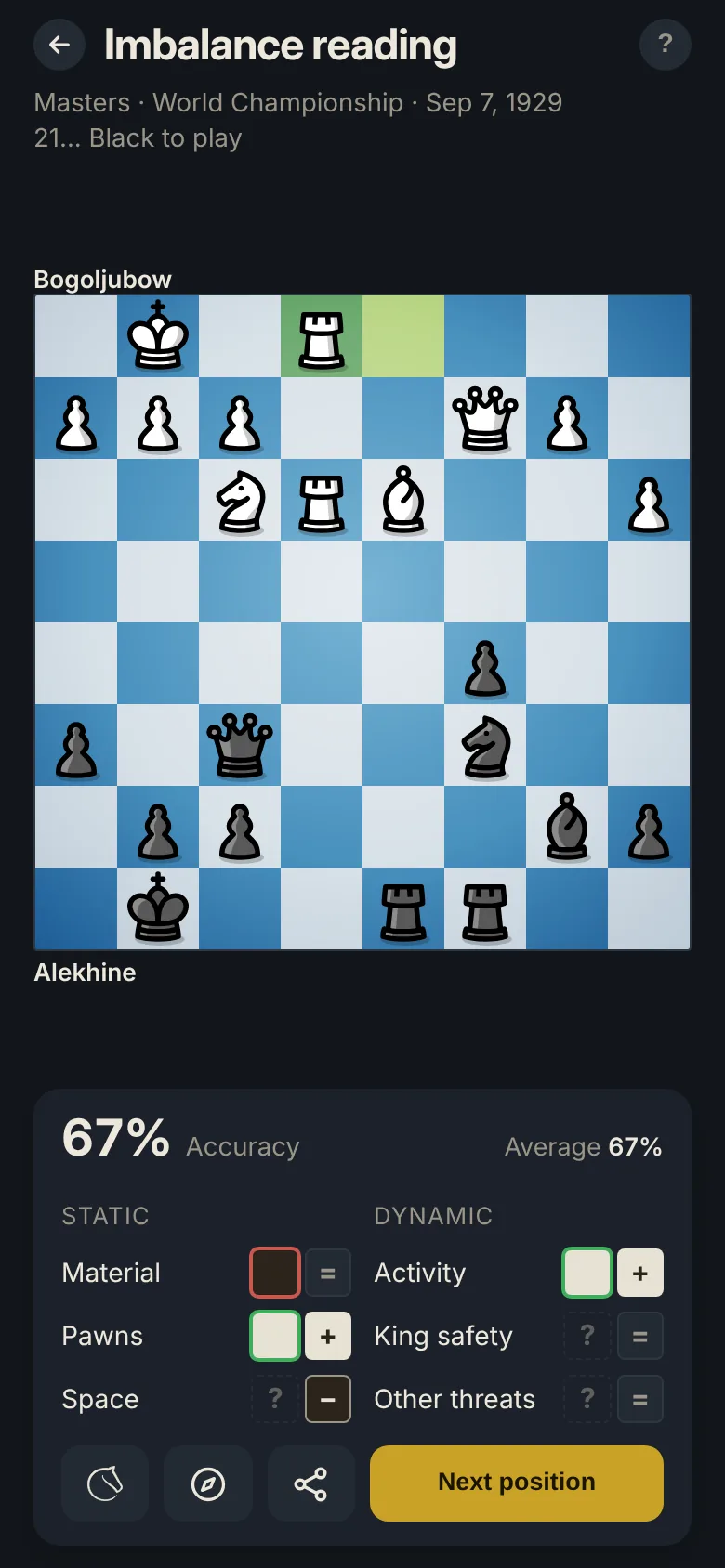
The six imbalances
- Material: pawn 1, knight and bishop 3, rook 5, queen 9; the bishop pair adds half a pawn.
- Pawns: passed and connected pawns, more as they advance; isolated, doubled and backward pawns count against.
- Space: pawns and the safe squares behind them in the centre.
- Activity: the safe squares your pieces reach, outposts, open files. Early on, Development instead.
- King safety: the pawn shelter against attacking pieces. Without queens, King activity instead.
- Other threats: material you can win right now, and threats for the next move, like a pawn push that attacks a piece.
Material, Pawns and Space are static: they tend to last. The others are dynamic: use them before they fade.
The exercise
Choose 3 of the imbalances that decide the position (there can be more than 3), and who has the edge. The review shows each one's size: = balanced; + or ++ a small or big edge for White, − or −− for Black. A choice among the 3 biggest edges, on the right side, scores full points; a smaller edge, half; a balanced one or the wrong side, nothing.
Find the ++ first. One big imbalance can outweigh several small ones, and tactics beat them all.